

AI sales training is becoming one of the most practical ways insurance agents can build confidence before speaking with live prospects. Insurance sales is not just about knowing the product, it is about knowing how to guide a conversation toward the right next step.
For insurance agents, the right training gives producers a way to practice real sales conversations, sharpen objection handling, and improve delivery before they speak with real prospects.
Agents have to ask better questions, uncover the real need, explain coverage clearly, handle objections, and help prospects make decisions without sounding pushy or scripted. That takes practice.
The problem is that most agents do not get enough realistic practice before they are on a live call with a real prospect.
With AI roleplay, agents can practice realistic conversations, receive feedback, and sharpen the exact skills that matter before the next real sales call.
In this article, we will break down what AI sales training is, why it matters for insurance agents, what skills it can improve, and how agents and agencies can use it to build stronger, more confident sales teams.
What Is AI Sales Training for Insurance Agents?
AI sales training for insurance agents uses artificial intelligence to help agents practice real sales conversations in a controlled training environment.
Instead of practicing only with a manager, teammate, or trainer, an agent can roleplay with AI and work through real-world sales situations such as:
- Prospecting calls
- Discovery conversations
- Appointment-setting conversations
- Life insurance objections
- Final expense objections
- Medicare or health insurance concerns
- Policy review conversations
- Follow-up conversations
- Closing conversations
The goal is not to replace human coaching. The goal is to give agents more repetition, more structure, and more feedback so they can improve faster.
Traditional sales training often tells agents what to say.
AI sales training helps agents practice how to say it.
That difference matters because insurance sales conversations are personal. Prospects may be confused, cautious, emotional, skeptical, or unsure. The agent has to know how to respond with confidence, empathy, and control.
Why Insurance Agents Need AI Sales Training
Most agents do not fail because they lack motivation. Many fail because they are undertrained for the conversations they are expected to handle.
Insurance agents are often asked to sell products that require trust, timing, education, and emotional clarity. A prospect may say:
- “I need to think about it.”
- “I need to talk to my spouse.”
- “I cannot afford it.”
- “I already have coverage.”
- “Mail me some information.”
- “Let me think about it.”
These are not just simple objections. They are moments where the agent either keeps control of the conversation or loses the opportunity.
According to the U.S. Bureau of Labor Statistics, insurance sales agents are expected to explain policy options clearly, evaluate client needs, and help clients choose suitable coverage, which is why stronger sales practice matters.
Reading a script can help. Watching a training video can help. Listening to top producers can help.
But none of those create the same skill development as live practice.
AI sales training gives agents a place to make mistakes, hear themselves respond, improve their delivery, and practice again before real money is on the line.
The Biggest Problem with Traditional Insurance Sales Training
Traditional insurance sales training is often too passive.
Agents may sit through webinars, watch recorded videos, read scripts, or attend team meetings. That information may be useful, but it does not always translate into better conversations.
An agent can understand an objection in theory and still freeze when a prospect says it on a live call.
An agent can memorize a script and still sound robotic.
An agent can know the product and still struggle to explain it in a way the prospect understands.
The reason is simple: knowledge is not the same as performance.
A stronger training system creates a simple improvement loop:
How AI Sales Training Helps Insurance Agents Improve
AI sales training can help agents improve the parts of the sales conversation that are hardest to master through theory alone.
Better Objection Handling
Objection handling is one of the biggest areas where insurance agents need practice.
Many agents know common objections, but they do not always know how to respond in a calm, confident, and natural way. AI roleplay allows agents to practice objections repeatedly until their responses become smoother.
Instead of panicking or overexplaining, agents can learn to slow down, ask better questions, clarify the real concern, and guide the prospect back to the value of the coverage.
Stronger Discovery Questions
Insurance sales is not just pitching. It is diagnosing.
A strong agent knows how to ask questions that uncover the prospect’s needs, concerns, family situation, financial priorities, and decision-making process.
AI sales training can help agents practice asking better discovery questions instead of jumping too quickly into product details or price.
Better discovery leads to better conversations.
Improved Call Control
Call control does not mean being aggressive. It means guiding the conversation with confidence.
Many agents lose control when the prospect changes the subject, gives vague answers, asks for a quote too early, or tries to end the call before the need has been fully uncovered.
AI roleplay can help agents practice keeping the conversation organized, moving forward, and focused on the next best step.
More Confidence with Closing
Closing is difficult for agents who have not practiced it enough.
Some agents hesitate because they do not want to sound pushy. Others overtalk because they are uncomfortable asking for a decision.
AI sales training gives agents a way to practice closing language, timing, transitions, and follow-up questions until the close feels more natural.
Faster Development for New Agents
New agents need repetition. They need to hear objections, practice responses, and get comfortable with the structure of a real sales conversation.
AI sales training can help new agents ramp up faster because they do not have to wait for a manager, trainer, or live lead to practice.
They can work through beginner scenarios, improve their confidence, and build a stronger foundation before handling more advanced calls.
Sharper Skills for Experienced Agents
AI sales training is not only for new agents.
Experienced producers can use AI roleplay to sharpen advanced skills, test new talk tracks, improve recovery when a call goes sideways, and stay sharp between live sales conversations.
Even strong agents benefit from repetition.
The best athletes still practice. The best salespeople should too.
What an AI Sales Training Platform Include
Not every AI training tool is the same. Insurance agents and agencies should look for a platform that supports real sales improvement, not just generic chatbot conversations.
A strong AI sales training platform should include:
Realistic Roleplay Scenarios
The training should feel close to real conversations agents actually have.
That means scenarios should include objections, hesitation, confusion, price concerns, timing issues, and different prospect personalities.
Skill-Level Training
A beginner agent and an advanced producer do not need the same practice environment.
A good AI sales training system should allow agents to practice at different levels so the experience matches their current skill set.
Feedback After Each Session
Practice is helpful, but feedback makes it more valuable.
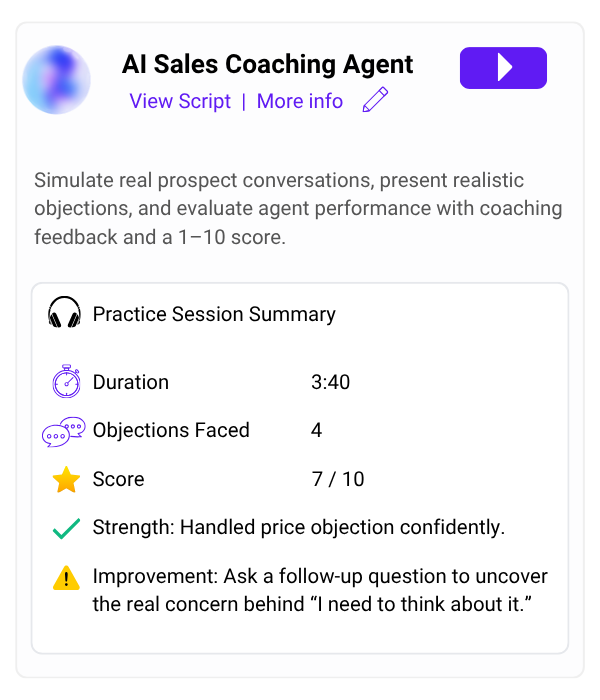
Agents should be able to see where they did well, where they lost control, and what they need to improve next.
Objection Handling Practice
Objections are where many insurance sales conversations are won or lost.
The platform should allow agents to practice common objections and improve how they respond under pressure.
Recordings and Transcripts
Recordings and transcripts help agents review their conversations and understand exactly what happened.
This is useful for self-improvement, manager coaching, and team development.
Manager Visibility
For agencies, IMOs, and teams, AI sales training should not only help individual agents. It should also give managers visibility into how agents are practicing and where they may need coaching.
This turns sales training from a one-time event into an ongoing improvement system.
AI Sales Training vs. Traditional Sales Coaching
| Traditional Sales Coaching | AI Sales Training |
|---|---|
| Often happens occasionally during meetings, reviews, or scheduled coaching sessions. | Gives agents a way to practice more consistently between live sales conversations. |
| Usually reviews mistakes after a call has already happened. | Helps agents prepare before the next real prospect conversation. |
| Depends heavily on manager, trainer, or teammate availability. | Allows agents to roleplay scenarios without waiting for someone else to be available. |
| Teaches concepts, scripts, and sales strategy. | Helps agents practice delivery, objection handling, call control, and closing confidence. |
| Can be uncomfortable or inconsistent when roleplay only happens in team settings. | Creates a repeatable practice environment where agents can improve through feedback and repetition. |
The strongest sales development system uses both. Human coaching provides leadership, judgment, and real-world experience. AI sales training gives agents the repetition they need to get sharper before live conversations.
How Agencies Can Use AI Sales Training
AI sales training is especially useful for agencies and teams that want a more consistent development process.
Here are practical ways agencies can use it.
New Agent Onboarding
Agencies can use AI sales training to help new agents practice core conversations before they start handling live opportunities.
This can include opening a call, building rapport, asking discovery questions, explaining coverage, handling price objections, and setting appointments.
Weekly Skill Practice
Sales conversations are like game-time performance. Agents should not wait until a live prospect call to practice the skills they need under pressure.
Agencies can create weekly practice assignments that help agents sharpen one skill at a time.
Discovery practice
Price objection practice
Follow-up conversation practice
Closing practice
Review feedback and coaching notes
Objection Handling Drills
Agencies can create focused practice around the objections that cost them the most opportunities.
This may include:
- “I need to think about it.”
- “I need to talk to my spouse.”
- “Let me check my budget.”
- “I already have insurance.”
- “Mail me the information.”
The more agents practice these moments, the more prepared they become when they happen live.
Coaching Support for Managers
Managers cannot listen to every practice call or personally roleplay with every agent every day.
AI sales training helps managers support more agents by giving them a structured way to review practice performance, identify weak areas, and focus coaching time where it matters most.
Ongoing Development for Top Producers
Top producers need development too.
AI sales training can help experienced agents practice tougher scenarios, refine their talk tracks, and improve consistency without waiting for formal coaching sessions.
What Skills Should Insurance Agents Practice with AI?
Insurance agents can use AI sales training to practice the skills that matter most during real prospect conversations.
The first few moments of a call matter. Agents need to sound confident, clear, and professional without sounding robotic.
Strong questions help uncover the prospect’s real need, urgency, budget, concerns, and decision-making process.
Insurance can be confusing. Agents need to explain coverage in a way that is simple, accurate, and easy to understand.
Price objections are common. Agents need to know how to respond without discounting the value of the protection.
Good insurance sales conversations help prospects understand why the decision matters without using fear-based pressure.
Agents need to practice moving from conversation to decision without sounding awkward or uncertain.
Real sales calls are not perfect. AI roleplay can help agents practice recovery when the prospect interrupts, objects, changes direction, or becomes unsure.
Why AI Sales Training Matters More in Insurance
Insurance sales is different from many other sales industries because the decision is personal. A policy may affect a family, a business, a retirement plan, or someone’s financial future.
That means agents need more than product knowledge or a memorized script. They need to practice how to create trust, explain value, handle hesitation, and guide the conversation with confidence.
AI sales training gives agents a practical way to build those skills through realistic repetition before they are speaking with a live prospect.
When agents practice better, they speak with more clarity. When they speak with more clarity, they create more trust. And when they create more trust, they give themselves a better chance to turn conversations into business.
How to Choose the Right AI Sales Training Tool for Insurance Agents
When comparing AI sales training tools, look beyond the word “AI.” The real question is whether the platform helps agents improve the actual conversations that drive production.
Practice realistic insurance sales conversations
Work through common objections and tough prospect responses
Receive structured feedback after practice sessions
Review session performance and improve over time
Support both individual agents and agency teams
Train at different skill levels, from new agents to experienced producers
The best AI sales training platform should feel practical, not complicated. Agents should be able to practice, get feedback, and know what to improve next.
Frequently Asked Questions
Here are some of the most common questions insurance professionals ask about AI sales training for insurance agents.
What is AI sales training for insurance agents?
AI sales training for insurance agents is a way for agents to practice sales conversations with artificial intelligence. Agents can roleplay real scenarios, handle objections, improve call control, and receive feedback before speaking with live prospects.
Can AI sales training replace a sales manager?
No. AI sales training should support managers, not replace them. Managers still provide leadership, strategy, accountability, and real-world coaching. AI helps agents get more practice and gives managers a more consistent way to support development.
Is AI sales training good for new insurance agents?
Yes. AI sales training can be especially helpful for new agents because it gives them a safe place to practice before live calls. They can build confidence, learn call structure, and improve objection handling without risking real opportunities.
Can experienced insurance agents benefit from AI sales coaching?
Yes. Experienced agents can use AI sales coaching to sharpen advanced skills, practice difficult objections, test new scripts, and stay consistent. Sales skills can always be improved with repetition and feedback.
What types of conversations can insurance agents practice with AI?
Insurance agents can practice prospecting calls, discovery conversations, appointment setting, follow-ups, objection handling, closing conversations, policy review discussions, and other sales scenarios.
Why is roleplay important in insurance sales training?
Roleplay helps agents move from knowing what to say to actually being able to say it under pressure. Insurance sales conversations often include hesitation, objections, and emotional decision-making, so agents need realistic practice.
How does AI help with objection handling?
AI can simulate common objections and allow agents to practice responding in real time. This helps agents improve confidence, tone, pacing, questions, and conversation control.
Is AI sales training only for life insurance agents?
No. AI sales training can be useful across many areas of insurance, including life insurance, final expense, Medicare, health insurance, property and casualty, commercial insurance, and recruiting conversations.
Conclusion
AI sales training for insurance agents is becoming more important because agents need more than scripts and product knowledge. They need realistic practice, consistent feedback, and the confidence to guide real conversations.
Insurance sales is built on trust. Agents have to ask the right questions, explain value clearly, handle objections, and help prospects make informed decisions.
For individual agents, AI sales coaching can help build confidence before live calls. For agencies and teams, it can create a more consistent training system that helps agents practice, improve, and stay sharp.
The agents who practice better are better prepared for the conversations that drive production.